1.0
How the Engine Works
1.1 The four axes
The four letters describe four different dramatic conflicts: how a goal is pursued, how influence is exercised, what motivates action, and what limits action. A character can be protective and ruthless, brilliant and self-defeating, governed by a cruel code or inventive without one. Every pole can make an interesting villain or antihero.
| Axis | Positive (+1) | Negative (−1) | Items |
|---|
Method (C/R) — Conspiring works through patience, concealment and delayed payoffs; Rampaging acts openly and forces a turning point now. Neither side automatically means clever or reckless.
Influence (M/D) — Manipulating bends relationships and interpretation to gain cooperation; Dominating declares authority and demands visible obedience.
Motive (V/O) — Vengeful needs the past answered; Opportunistic follows present openings. A grudge is not the same thing as an ethical code.
Limits (P/U) — Principled obeys a self-chosen red line even at a cost; Unbound revises vows when the situation changes. P does not mean good and U does not mean evil.
1.2 The scoring contract
Every item addresses one axis only; no response alters two scores. Question order is interleaved, and option A is not consistently the positive answer — its positions are balanced within each axis.
On each question the keyed positive option adds +1 to its axis and the other adds −1. The sum is that axis's signed vote margin. A positive total selects C, M, V or P; a negative total selects R, D, O or U. In a zero tie, the earliest-numbered question for that axis is its predesignated anchor and chooses the pole — and the tie is disclosed in the result. Because Limits has an odd 35 items it cannot tie when every question is answered. No missing answers are scored.
Orientation and realm never touch a margin. The same completed answers can be reinterpreted through either lens without rescoring.
1.3 How to read a margin
A result line such as Motive O · V 2 vs O 3 · margin −1
reads left to right:
- Motive — which axis this row is about.
- O — the letter that won, and the one that appears in your four-letter code.
- V 2 vs O 3 — the raw count. Two choices pointed toward Vengeful, three toward Opportunistic.
- margin −1 — the difference, signed. Negative selects the second pole (R, D, O or U); positive selects the first (C, M, V or P).
A margin of ±1 is a close lean: one different answer would have produced a different letter. The result says so when that happens. A big margin means the answers were consistent, not that the trait is strong — there is no intensity in this engine, only direction.
A margin is a count of story choices. It is not a measurement of a person.
1.4 The tether: a second and third reading
Some stories pair you with one other person. Those stories key every beat a second time, so the same twenty answers are read twice: once for you, once for the partner you were tethered to. Nothing is asked twice and nothing about your own result changes — the partner's code is a second angle on the same decisions, not a separate character sheet.
A third reading then reports what passed between you. On each beat the partner has a position, and that position sits in either the Humanity or the Bizarro world. Comparing it to what you actually chose gives four outcomes:
- RESISTED — harmful influence was resisted.
- YIELDED — harmful influence changed your behaviour.
- RECEIVED — helpful influence changed your behaviour.
- REJECTED — helpful influence was refused.
These four are peers, not a ranking. Resisting influence is not scored as virtue and accepting it is not scored as weakness: helpful influence can correct a blind spot, and harmful influence can still pay in the short term. There is no total, and the tether never moves your code, your world, or your realm.
The result also compares the two codes letter by letter. Where you and your partner share a letter the reading is resonance — you work the same way on that axis. Where you differ it is friction or tension: two different methods meeting, which is not the same thing as conflict in the story. Each axis is named for what it is a channel for — method (C/R), channel (M/D), motive (V/O) and boundary (P/U).
Coverage is partial on purpose: only some stories are tethered, and the rest show no partner at all rather than an empty one.
Horde influence
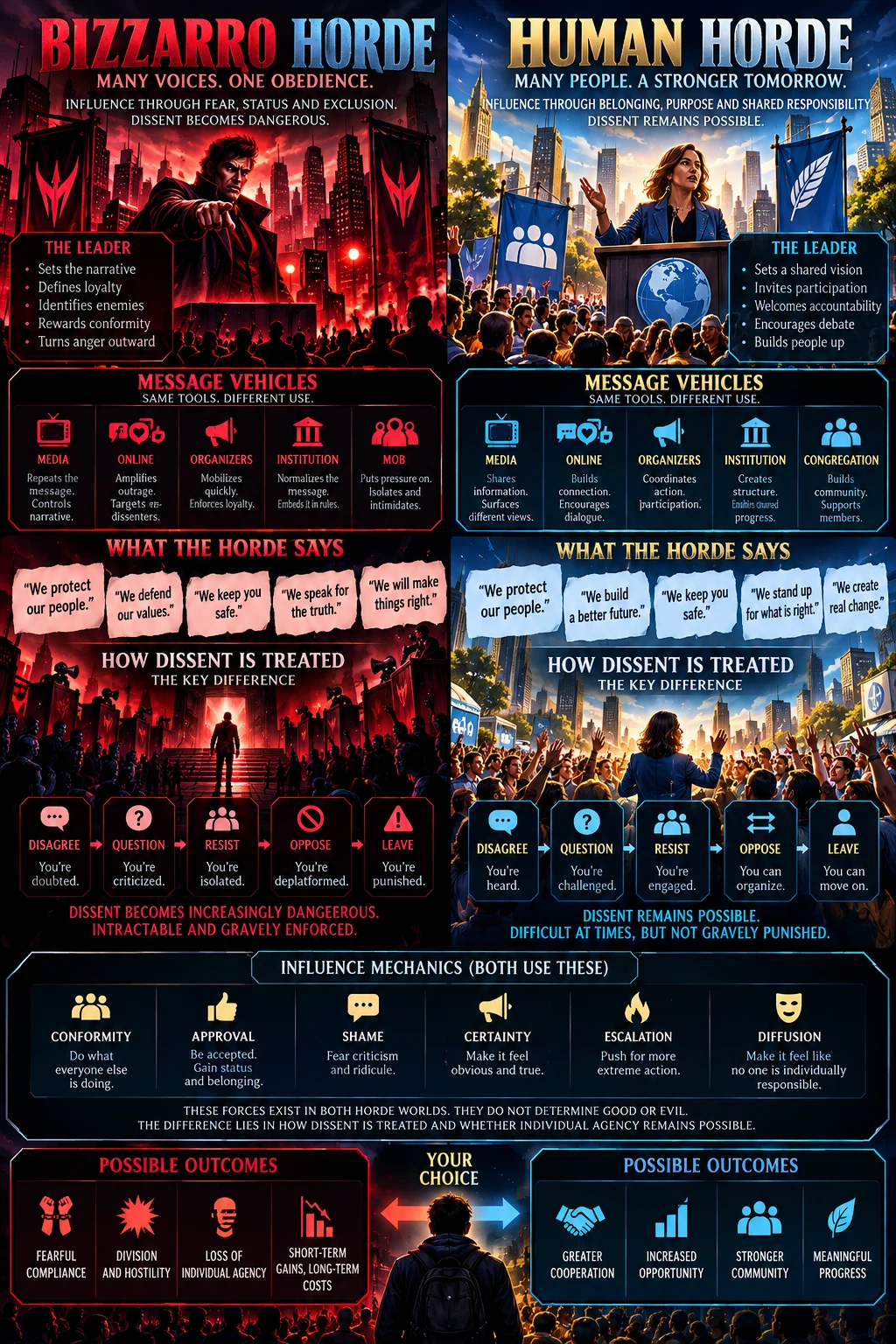
A Horde story uses the same tether for a group and its leader or exemplar. The same twenty choices produce your reading, the secondary tether reading, and the same four influence counts above. There are no new codes, pressure scores, dissent meters or outcome classes. Your world, realm and cost card still come from the existing rules.
The group’s claim is recorded as what it says, not as certified truth. Its demand, affected people, message vehicles, pressure and cost of dissent are authored story context. A chair does not certify the group’s direction, and media, online networks, institutions and gatherings are vehicles — not moral classifications.
Both directions can use conformity, approval, shame, certainty, escalation and shared responsibility. The narrative distinction is what happens when a member questions, disagrees, resists, opposes or leaves. In a Human reading, those routes remain possible, even when difficult. In a Bizarro reading, disagreement increasingly brings exclusion or punishment and responsibility is shifted away from individual decisions. None of this adds a hidden score.
Every existing archetype reading includes a Horde Leader Profile in both directions: how the capacity affects groups, handles dissent and owns consequences. These describe fictional capacities, not a diagnosis or a judgment of real people.
Human and Bizarro Horde: illustrated context
The illustration contrasts belonging with obedience, accountable leadership with displaced responsibility, and possible dissent with escalating penalties. Its possible outcomes are narrative examples, not additional engine results.
1.5 Capacity → Choice → Consequence
Planning isn't evil. Power isn't evil. Persuasion isn't evil. Force isn't evil. Remembering a wrong isn't evil. Adaptability isn't evil. Having principles isn't automatically good, and breaking convention isn't automatically bad.
Capacity is what you are naturally capable of. Choice is where you point that capacity. Consequence is what that choice does to other people and the world. The nine realms are where those choices actually matter.
A player doesn't take a quiz and discover they're evil. They discover their machinery. Then the story puts that machinery under pressure.
Content boundary: the 143-question bank is written for a villain-framed alter ego. The Humanity switch reinterprets its four-letter result for fiction; it is not a separate, neutrally worded hero questionnaire, and it is not evidence that heroic orientation was measured.