3.0 / A world of consequences

The 9 Realms

Nine settings. Two lenses.
What will your choices build?

From the land that feeds us to the skies that connect us, every realm holds a promise — and a pressure that can turn it inside out.

Explore the realms ↓ Choose a story to play → Meet Tether & Horde ↓ Explore the Lens Effect ↓

The realm atlas

Choose your setting

Jump to a realm. Discover what it protects, what threatens it, and the question at its heart.

A realm is a laboratory for the code, not a modifier of it. Choosing a realm never changes an axis total — it supplies context, two opposing fictional lenses, and a question to drive writing. These are views within this fictional universe, not claims that real communities, faiths, families, or institutions belong to one moral category.

Within every setting / Between people

The forces between us

Realms describe where you stand.
Tether and Horde describe whose pull you feel.

The setting holds the situation. Relationships give it gravity. These are not more realms, but another way into the same story.

The personal pull

Tether

One person can change what a choice costs.

A spouse, a friend, a business partner. Someone whose trust, expectations, or shared history carries weight. The bond may steady you, challenge you, or make a familiar choice feel different.

Tether is that relationship's gravity: not simply who stands beside you, but how their presence enters your decisions.

Carry this into the story

Whose voice stays with you when the choice is yours?

How Tether is read →

The collective pull

Horde

It feels different when everyone is saying it.

A circle, a movement, a community. Shared purpose, repeated messages, and the wish to belong give a group its pull. It can reach you through a leader, a screen, or the people beside you.

Horde brings the tether into a group: what passes between your own judgment and the voices around it.

Carry this into the story

What changes when your answer is not the room's answer?

How Horde is read →

In stories that include them, these readings come from the same choices you already make. They add no scoring axis and do not alter your code, world, realm, or consequence bars.

Within every setting / Behind every interpretation

The Lens Effect

Same story. Different lens. Different meaning.

A face, an image, or a first impression can pull your attention before a character acts. The Lens Effect is a prompt to notice that pull, separate appearance from action, and check your interpretation against what happens in the story.

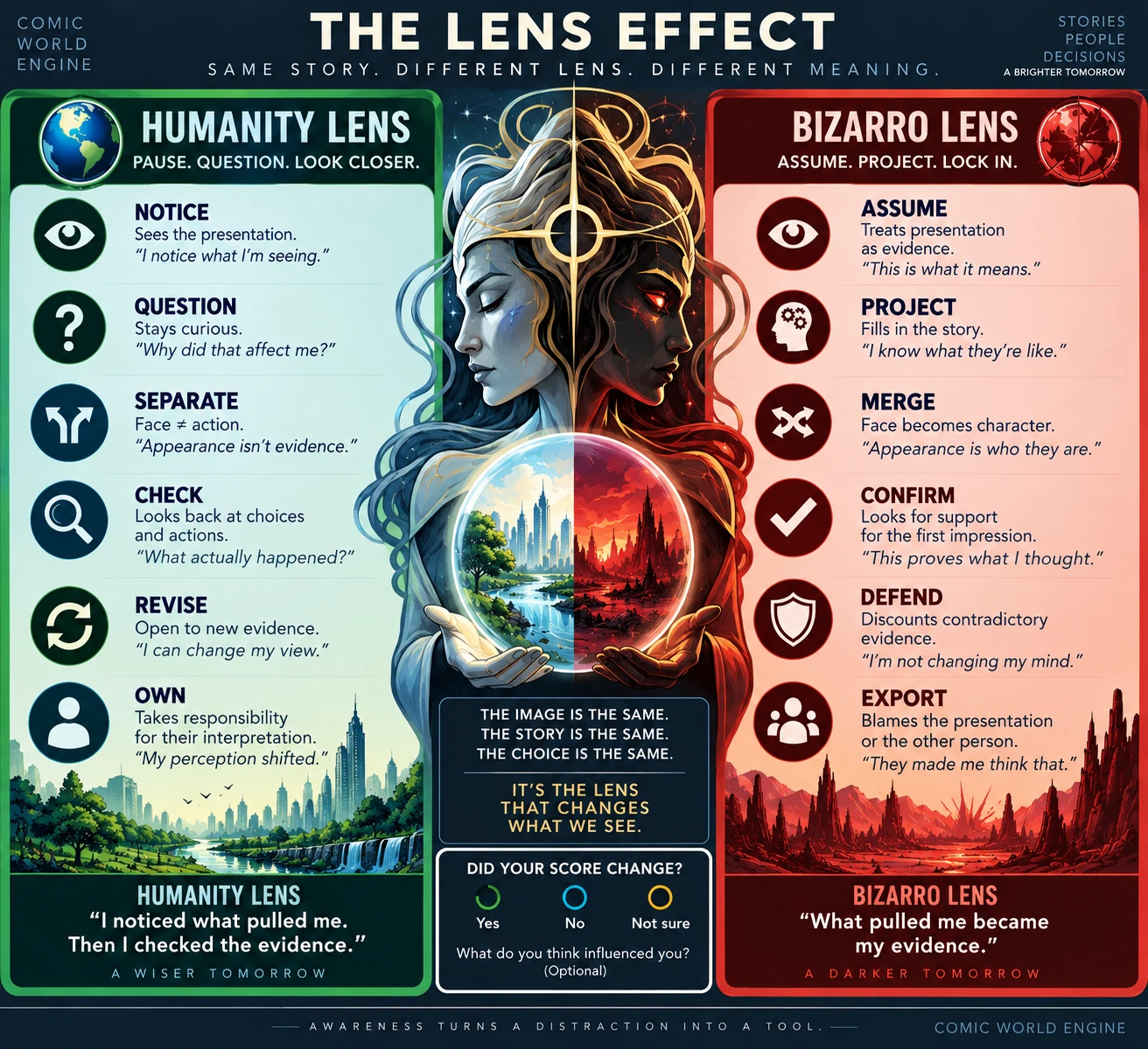
The Lens Effect: a split portrait and world between Humanity and Bizarro lenses. Open Read both perspectives for the twelve steps in text.
Two perspectives, one world. Open the full-size illustration.

Humanity lens

Pause. Question. Look closer. Notice what pulls you, then check the choices and actions.

Bizarro lens

Assume. Project. Lock in. A first impression becomes the evidence instead of being checked.

These are reflection prompts, not labels assigned to you. The same answers produce the same scores; a replay difference does not prove what caused it.

Carry this into the story

What pulled your attention — and what do the character's choices actually show?

How this relates to scoring →
Read both perspectives — twelve reflection steps

Humanity lens

“I noticed what pulled me. Then I checked the evidence.”

  • Notice: See the presentation. “I notice what I’m seeing.”
  • Question: Stay curious. “Why did that affect me?”
  • Separate: Face is not action. “Appearance isn’t evidence.”
  • Check: Look back at choices and actions. “What actually happened?”
  • Revise: Stay open to new evidence. “I can change my view.”
  • Own: Take responsibility for your interpretation. “My perception shifted.”

Bizarro lens

“What pulled me became my evidence.”

  • Assume: Treat presentation as evidence. “This is what it means.”
  • Project: Fill in the story. “I know what they’re like.”
  • Merge: Make a face stand for character. “Appearance is who they are.”
  • Confirm: Look for support for a first impression. “This proves what I thought.”
  • Defend: Discount contradictory evidence. “I’m not changing my mind.”
  • Export: Blame the presentation or the other person. “They made me think that.”

What changes in play? In a text/illustrated replay of the same story, the story and available choices stay the same; prepared cast portraits change the presentation. The same answers produce the same scores. If you choose differently, results can show the changed choices and their score differences — not prove that artwork caused them. Memory, order, and reconsideration can also matter. A single run has no before-and-after comparison.

These are fictional perspectives, not labels the app assigns to you. Looking at artwork does not make a choice “Bizarro,” and a changed or unchanged score does not establish either lens. This reference adds no realm, scoring axis, hidden measurement, or diagnosis.

Carry this into the story / Optional reflection

Did your score change — yes, no, or not sure? What do you think influenced you? Which choices and actions support your interpretation?

The setting is only the beginning

Step into the story.

Choose a Quick Play scenario to see what your decisions build, or meet the sixteen archetypes that can inhabit these worlds.

Choose a story to play → Meet the 16 archetypes →